
Go-to-market, 1 year
Woodland had the manufacturing capability to build a full line of solid wood doors. What it didn’t have was a standardized catalogue, and a category with real revenue potential sat mostly untapped. Once the company’s new e-commerce platform was live, I had both the sales data and the infrastructure to close that gap.
Building the line from scratch
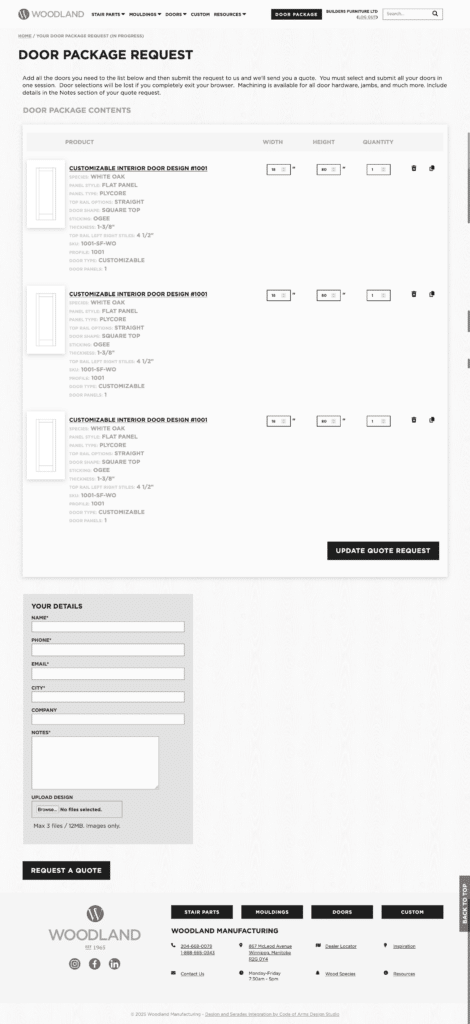
I developed Woodland’s door line end to end: product design, photography and digital assets, a full suite of print materials for catalogues, brochures, and in-store displays, and an interactive online configurator built to make quoting fast and customization the obvious choice rather than a special request. Every option renders visually, so a customer sees exactly what they’re ordering, including popular options like glass panels, instead of decoding a spec sheet. Premium positioning ran through all of it: this was a luxury product, priced for the right buyer.
Taking it to market
I took the line to market across digital, print, and in-store over the course of a year, partnering with dealers to carry it both on their showroom floors and on their own e-commerce platforms.
What happened next
Demand outpaced the rollout. Orders came in before manufacturing had finished training staff on the new line, and quote volume climbed to a level that forced us to restructure how leads were distributed across the sales team. Ten dealer storefronts picked up door displays within six months, fast even by industry standards. The line reached customers who’d had no prior reason to buy from Woodland at all, while deepening relationships with the dealers we already had.
What this proved
This is where the people side of the work mattered as much as the strategy. Getting a brand-new product line to market in a year meant staying genuinely close to sales, purchasing, production, and the dealers themselves, and closing every loop between them before it became someone else’s problem.
The e-commerce platform gave Woodland something to sell. The door line proved what selling it well could do. The next piece covers the layer that tied it together: the brand architecture, messaging strategy, and visual identity built around it.